 Skip to content


7 Hidden Ways Small-Batch Cosmetics Shape Waste
Quick Summary
Small-batch cosmetic production can reduce environmental waste mainly by limiting overproduction and unsold stock, but batch size alone does not determine a product's total footprint. Packaging, ingredients, facility practices and end-of-life disposal can each outweigh the savings from making less at once. Buyers should judge small-batch claims on documented evidence.
- Producing closer to demand can cut overproduction and unsold inventory.
- Packaging can make up about 35% of a product's footprint, per a single 2026 Devera analysis.
- Shipping small orders by parcel can partly offset overproduction savings.
- Ask whether brands report water, energy, emissions and unsold-product rates.
- Check whether packaging components are actually accepted by your local recycling program.
Table of Contents
- What Small-Batch Cosmetic Production Means
- Small-Batch vs. Mass Production Cosmetics: Where the Footprint Differs
- Cosmetics Manufacturing Waste: Overproduction, Inventory and Facility Impacts
- Environmental Impact of Cosmetic Packaging and Plastic Waste
- Sustainable Beauty Ingredients: Sourcing, Biodegradability and Aquatic Effects
- Trade-Offs of Smaller Production Runs
- A Sustainability Checklist for Judging Small-Batch Claims
- Choosing Small-Batch Beauty You Can Verify
- Frequently Asked Questions
Small-batch cosmetics are often pitched as the greener choice, but the environmental case is more complicated than the marketing suggests. Producing closer to demand can cut overproduction and unsold stock, yet batch size on its own does not tell you the total footprint of a product. This guide walks through where the impact really sits, from ingredients and packaging to disposal, so you can judge small-batch claims on evidence rather than appeal.
Start with the packaging.
What Small-Batch Cosmetic Production Means
Small-batch production means making a limited quantity of a product in each run, often with hand finishing and tighter quality checks. Our guide to why small-batch makeup can last longer explains how production choices affect product life and waste. The appeal is straightforward: a brand that makes less at a time is less likely to end up with excess inventory sitting in a warehouse. Industry commentary on small-batch manufacturing argues that producing smaller quantities when starting out means less waste, though those sources rarely provide measured reductions.
Scale is not the same as sustainability, however. A small batch can still use heavy single-use packaging, energy-intensive processing, or ingredients sourced from distant supply chains. Before accepting the label, ask what the brand actually measures.
Small-Batch vs. Mass Production Cosmetics: Where the Footprint Differs
The core difference is how closely output tracks demand. For a direct comparison of small-batch and mass-produced makeup, see the side-by-side breakdown. Mass producers run large batches to lower per-unit costs, and any mismatch between forecast and sales becomes surplus. Small-batch producers accept higher per-unit costs in exchange for flexibility, which can reduce the share of product that goes unsold. Read a summary of what artisanal small-batch cosmetics offer over mass-produced ones for the key differences.
Life-cycle research supports looking at the whole chain rather than one stage. Life-cycle thinking looks at environmental, social and economic impacts from design and development through use and end of life. Batch size shapes only some of those stages. Formulation, packaging, transport and disposal can each outweigh the savings from producing less at once.
This is why small-batch brands should be evaluated on total impact per unit sold, not batch size alone.
Cosmetics Manufacturing Waste: Overproduction, Inventory and Facility Impacts
Overproduction is the most cited source of manufacturing waste. Products that never sell are discarded, reformulated or discounted, and each outcome carries its own footprint. Smaller runs can reduce this exposure, which is the strongest argument for small-batch production.
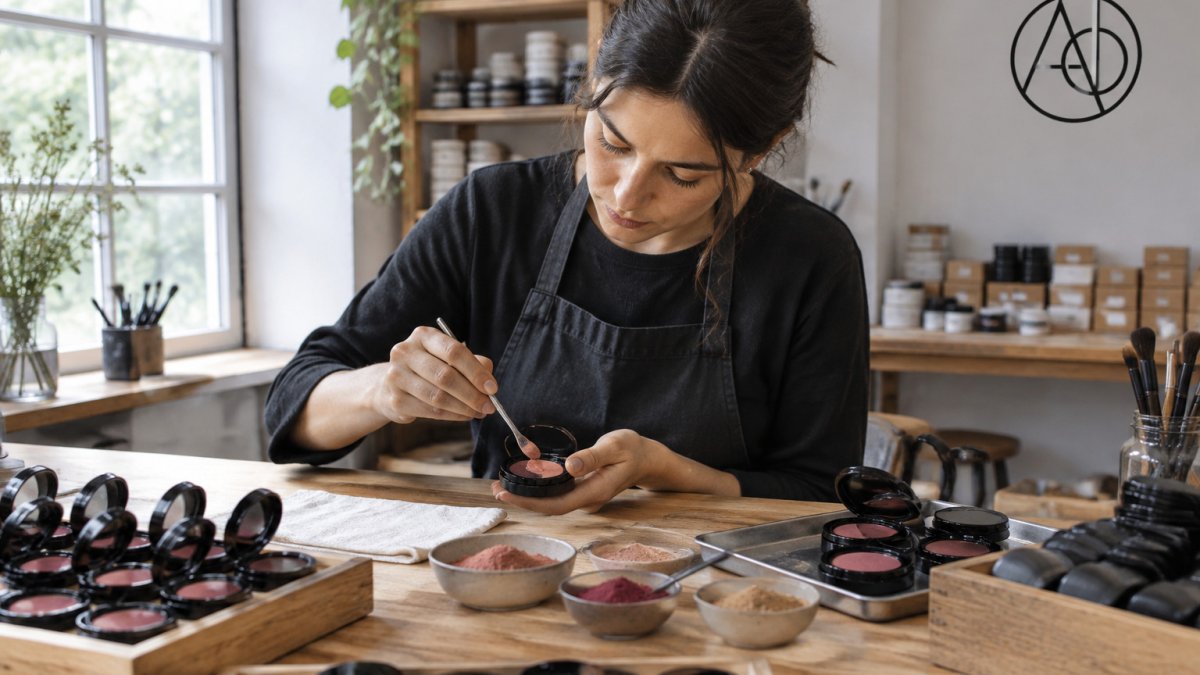
Facility operations matter too. Cleaning between formulation runs uses water and generates wastewater, and equipment that runs for shorter, more frequent batches can consume energy differently from a continuous line. A 2022 cleaner-production assessment reported a 9.0% reduction in VOC emissions from cosmetic manufacturing, showing that process improvements can deliver measurable gains regardless of scale. Ask whether a brand has audited its cleaning and emissions practices, not only its batch sizes.
Environmental Impact of Cosmetic Packaging and Plastic Waste
Packaging is where small-batch production most often loses the environmental argument it wins on overproduction. A small run can still ship in a heavy glass jar with a metallized cap, a multi-layer plastic compact, or a pump with a metal spring that no municipal recycling program will separate. Volume does not fix material choice.
The useful way to judge packaging is by end-of-life pathway, not by whether it looks natural. Four options dominate, and each carries a different trade-off:
- Refillable systems. A durable outer case paired with a lightweight refill pod cuts material per use over time, but only if the customer actually buys refills. A refillable compact that is used once and discarded carries a higher footprint than a simple recyclable one. Refill adoption rates, not refill design alone, determine the benefit.
- Recyclable mono-material packaging. Single-material PET or PP jars and tubes are more likely to be accepted by curbside programs than mixed-material assemblies. The catch is that small components, caps, droppers, shrink bands, labels, often disqualify an otherwise recyclable container. A common pattern is a recyclable body with a non-recyclable closure.
- Recycled-content packaging. Post-consumer recycled (PCR) plastic reduces demand for virgin resin, but PCR availability and quality vary by material, and some PCR streams are themselves downcycled. Brands that state a PCR percentage are more credible than brands that say "recycled" without a figure.
- Lightweighting. Reducing wall thickness, removing secondary cartons, and eliminating unnecessary outer boxes lowers material use per unit. This is often the cheapest environmental win available to a small brand, and it is also the easiest to verify, you can see whether a product arrives in a box inside a box.
A 2026 analysis from Devera reports that packaging materials make up about 35% of a product's overall environmental footprint, while cosmetic ingredients account for about 12%. Those figures come from a single source and do not specify whether they apply to small-batch products, so treat them as a starting point rather than a settled benchmark. The same source adds that most cosmetic packaging is discarded, which makes material choice a larger lever than many buyers assume.
Small-batch brands are not exempt. A handcrafted compact in a multi-layer plastic case can carry a large footprint despite small volumes, and a glass jar that feels premium may be heavier to ship than a plastic alternative, adding transport emissions that offset the material savings.
Watch out: "recyclable" on a package does not mean it will be recycled in your area. Check whether the specific components in your municipality's program accept the material, and treat brand claims about recyclability as a question to verify rather than a fact to accept.
Cosmetic packaging waste can reach landfill, so end-of-life design belongs in the environmental picture, not as a footnote. The practical test for a small-batch brand is whether it can tell you, component by component, what happens to its packaging after use, and whether it has chosen materials with that answer in mind.
Sustainable Beauty Ingredients: Sourcing, Biodegradability and Aquatic Effects
Ingredients affect the footprint through sourcing, processing and what happens after the product is washed away.
When evaluating a product, ask three questions: where the raw materials come from, whether key ingredients are biodegradable, and whether the brand has assessed aquatic toxicity. Small-batch formulas are not automatically cleaner, and a short ingredient list says little about environmental performance on its own.
Trade-Offs of Smaller Production Runs
Smaller runs bring real costs. For practical guidance on keeping pigment intensity consistent throughout wear, see our tips for all-day color. Small-batch production can reduce one category of waste while introducing others. The more useful frame is per-unit impact: what happens to energy, water, packaging, and transport when you divide by a smaller number of units.
Setup and changeover costs. Every production run carries fixed costs, equipment cleaning, sanitizing, line changeover, and quality testing. Spread those across 500 units instead of 50,000 and the per-unit burden rises. Cleaning between formulation runs uses water and generates wastewater, and equipment that runs for shorter, more frequent batches can consume energy differently from a continuous line. A brand that runs many small batches may use more cleaning water and energy per finished unit than a brand running fewer, larger ones.
Packaging and material intensity. Small orders often mean small packaging purchases, which can push a brand toward stock components rather than custom low-waste designs, and toward suppliers who ship in smaller quantities with more packaging per unit. Material intensity, packaging weight per product, is a measurable indicator here, and it often moves the wrong way as batch size falls.
Transport efficiency. A brand that cuts overproduction but ships small orders individually may not come out ahead on transport emissions. Less-than-truckload and parcel shipping carry higher emissions per unit than full truckloads, and small-batch brands frequently ship parcel. The overproduction savings can be real and still be partly offset by last-mile and small-order transport.
Consistency and rework. Consistency between batches can be harder to guarantee at small scale, and failed batches mean wasted ingredients, packaging, and energy. A batch that is reformulated or discarded carries its full footprint with no product to show for it. Rework and rejection rates belong in any honest accounting.
When small-batch helps. The approach tends to win when demand is uncertain, when products are perishable or freshness-sensitive, when runs are planned close to actual orders, and when the brand can consolidate shipping. It tends to lose when a brand runs many tiny batches with heavy cleaning between them, ships parcel to distant customers, or uses premium heavy packaging to justify a higher price.
Process improvements can deliver measurable gains regardless of scale. That is the key point: facility practice and process design can matter as much as batch size, and a large producer with an audited cleaning and emissions program may outperform a small producer without one.
The question for a buyer is whether a brand manages these trade-offs openly, whether it tracks unsold-product rate, material intensity, energy and water per unit, and emissions per product, not whether it simply makes less. A brand that can show those numbers is far more credible than one that relies on the word "small" alone.
A Sustainability Checklist for Judging Small-Batch Claims
Use this checklist before trusting a sustainability claim:
- Does the brand explain how batch size reduces waste, with figures rather than adjectives?
- Is there any life-cycle assessment, covering more than production alone?
- Is packaging reduced, refillable or made from recyclable materials, and is that stated clearly?
- Are ingredient sources and biodegradability disclosed?
- Does the brand report on water, energy and emissions at its facility?
- Are unsold products and returns handled transparently?
- Are claims backed by documentation that a reader can check?
Choosing Small-Batch Beauty You Can Verify
Small-batch cosmetics can offer an environmental advantage, particularly by limiting overproduction, but the advantage has to be demonstrated rather than assumed. Compare brands on total footprint: packaging, ingredients, facility practices and what happens to products at end of life.
At Artonit, we make our cosmetics in small batches with hand-finished details and pigment-saturated formulas. For current pricing, which depends on quantity and delivery, visit our website or request a quote directly. Buy what you will use, ask the questions above, and let the evidence, not the label, decide.
Last Updated: November 7, 2026
Frequently Asked Questions
Is small-batch cosmetic production better for the environment?
It can be, mainly because producing closer to demand can limit overproduction and unsold stock. However, the research available does not include measured comparisons showing a specific reduction for small-batch brands. Batch size is only one factor. Packaging, ingredient sourcing, transport and end-of-life disposal all contribute to total impact, so the most reliable way to judge a brand is to ask for evidence across those stages rather than assume that small output means a small footprint.
How does small-batch production reduce cosmetic waste?
Smaller runs make it easier to match supply to actual orders, which reduces the risk of leftover finished products being discarded. Producing in limited quantities can also reduce the amount of stock that sits in warehouses and expires before it is sold. These benefits depend on how a brand forecasts demand and manages inventory, so the reduction is not automatic. Ask a brand how it plans production and what happens to unsold units.
What is the environmental impact of cosmetic packaging?
Packaging is often a large share of a product's footprint. Look for brands that disclose their packaging materials and recycling pathways.
