 Skip to content


Why Luxury Cosmetics Are Worth the Price: A 2026 Guide
Table of Contents
- The Real Cost of Luxury Cosmetics: A Cost-Per-Use Framework
- Luxury vs Drugstore Makeup Ingredients: What Changes at Higher Price Points
- Is Expensive Makeup Better for Sensitive Skin?
- Luxury Makeup Performance Testing: How to Evaluate Longevity and Finish
- When to Splurge vs When to Save: A Decision Framework
- The Psychological Experience of Luxury Beauty and Why It Matters
- Small-Batch Production, Sustainability, and Ethical Sourcing
- How Artonit Approaches the Price Question
- Frequently Asked Questions
Last Updated: September 11, 2026
The Real Cost of Luxury Cosmetics: A Cost-Per-Use Framework
Why luxury cosmetics are worth the price comes down to a math problem most shoppers never run. A $32 eyeliner used four times a week for a year costs about 15 cents per application; a $6 drugstore pencil that dries out in six weeks costs more per wear. At Artonit, we built our pricing around that arithmetic: pigment-saturated formulas mean you use less product per application, so the cost-per-use gap between prestige beauty and mass-market narrows far more than the sticker price suggests.
The framework is simple: divide the price by the number of uses you realistically get before the product expires or runs out.
How to Calculate Cost-Per-Use for Any Makeup Product
Cost-per-use is the total price divided by the number of applications the product delivers before it expires or empties. A $36 lip product used five times a week for eight months works out to roughly 21 cents per wear; a $12 alternative that lasts three months costs about 23 cents per wear and often needs two or three passes to build the same pigmentation (the FDA).
Three variables decide the outcome:
- Pigment concentration. Highly saturated formulas need one pass, not three. That stretches the product across more uses.
- Shelf life after opening. Powders often last 12 to 24 months; cream and liquid formulas typically run 6 to 12 (the FDA). A product that spoils before you finish it wastes money.
- Application frequency. Daily users hit a lower cost-per-use than occasional users on the same product.
To run the numbers, track how many weeks a product actually lasts you, then divide. Most people find their cheapest-feeling purchase is their most expensive per wear.
Luxury vs Drugstore Makeup Ingredients: What Changes at Higher Price Points
Luxury vs drugstore makeup ingredients diverge in three measurable places: pigment load, binder quality, and the ingredients that sit on the skin. Prestige formulas typically carry a higher concentration of treated pigments and finer-milled powders, so a single sweep reads as opaque color rather than a chalky wash. Mass-market formulas often compensate with fillers like talc, which is why you reach for a second and third dip.
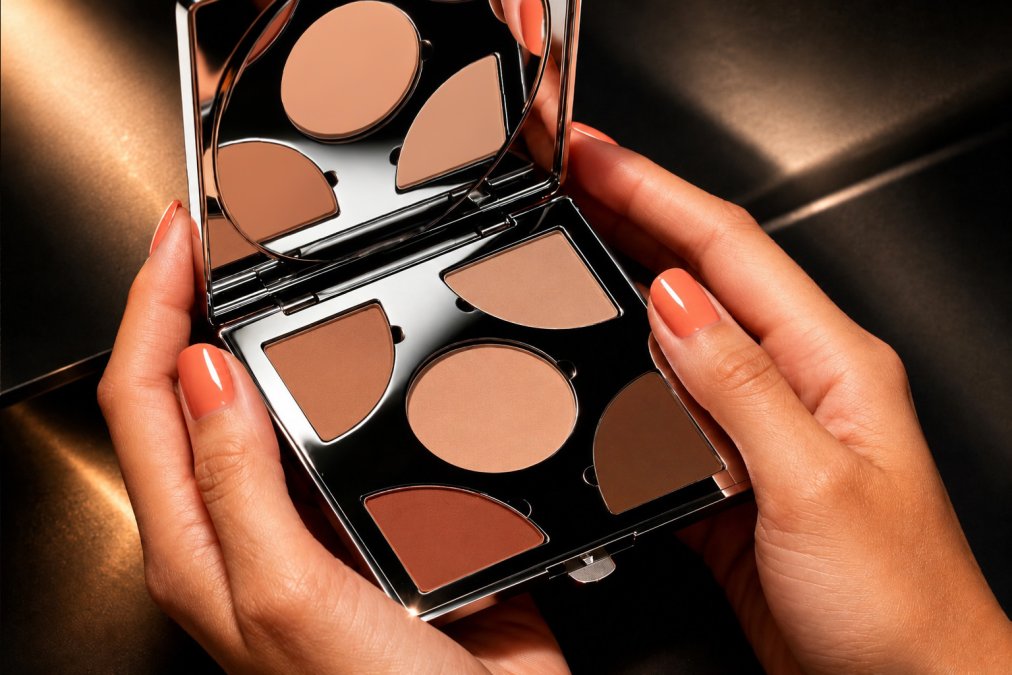
Close-up of a woman's hand holding a luxury eyeshadow compact open to reveal richly pigmented shades, with a soft-focus vanity mirror and natural light in the background
The gap isn't only about color payoff. Binders and emollients determine how a formula wears through a workday: cheaper binders can separate or turn patchy by hour four, while better ones hold pigment in place. For reactive skin, the base matters as much as the color, fewer fillers and more skin-compatible emollients generally mean less irritation over a long day.
Pigment Concentration and Why It Affects Longevity
Pigment concentration affects longevity because a single opaque layer resists fading better than three thin, uneven ones. When color sits in a dense, evenly bound film, it wears down uniformly instead of breaking into patches, the practical reason a saturated formula can look fresh at hour ten while a sheer one has already migrated.
Is Expensive Makeup Better for Sensitive Skin?
Is expensive makeup better for sensitive skin? Not automatically, but higher price points do tend to buy simpler formulations with fewer known irritants. The FDA's guidance on cosmetics and ingredient labeling confirms that cosmetic products and ingredients are not subject to premarket approval, which means the ingredient list on the box is your primary defense regardless of price. Prestige brands more often invest in dermatologist-tested, hypoallergenic, and non-comedogenic formulas because their customers demand it.
Fragrance, certain preservatives, and some dyes drive most reactions. A fragrance-free formula built around fewer, better-tolerated ingredients is a better bet for reactive skin, and that reformulation work is one of the things a higher price actually funds.
Luxury Makeup Performance Testing: How to Evaluate Longevity and Finish
Luxury makeup performance testing means measuring how a formula holds up across a full wear cycle, not how it looks in the first five minutes. The variables that matter are fade, creasing, transfer, and finish stability. A product can look flawless at application and be a different product entirely by hour eight.
What 12-Hour Wear Tests Actually Reveal
A 12-hour wear test reveals where a formula fails, not just whether it survives. Apply in the morning, photograph under the same light at hours 4, 8, and 12, and score four things:
- Fade. Does the color stay true, or does it dull and shift?
- Creasing. Does product settle into fine lines or lids?
- Transfer. How much comes off on a tissue or collar?
- Finish integrity. Does a satin stay satin, or turn shiny and uneven?
A formula that scores well across all four justifies a higher price; one that only survives because you applied three layers does not.
When to Splurge vs When to Save: A Decision Framework
Splurge where the formula does something a cheaper product physically cannot, and save where the difference is packaging or a logo. The trick is knowing which category a product falls into before you buy.
Product Category |
Splurge or Save |
Why |
|---|---|---|
Foundation and concealer |
Splurge |
Shade range, undertone accuracy, and skin-compatible ingredients drive daily wear |
Eyeshadow and blush |
Splurge |
Pigment load and blendability are hard to fake at a low price |
Mascara |
Save |
Short shelf life means you replace it before quality differences compound |
Lip liner |
Save |
Basic wax-and-pigment formulas perform well across price tiers |
Setting powder |
Either |
Fine-milling matters, but good mid-range options exist |
Eyeliner |
Splurge |
Longevity and glide separate prestige formulas from the rest |
The logic holds for most people: spend where the product touches the most skin for the longest time, and save on items you replace every few months anyway.
The Psychological Experience of Luxury Beauty and Why It Matters
The psychological experience of luxury beauty is not a vanity metric; it changes how you use a product, and how you use a product changes its real cost. A compact you enjoy opening gets reached for more often, and a product used consistently delivers a lower cost-per-use than one that sits untouched. That sensory experience, the weight of the case, the click of the closure, the texture of the formula, is part of what you're paying for, measurable in behavior, not just feeling.
The Mechanism: Ritual, Ownership, and Consistency
Three psychological levers explain why a premium product often outperforms a cheaper one in practice, even when the formulas are close:
- Ritual. A product with a deliberate opening sequence, a magnetic closure, a weighted cap, a mirror set into the lid, turns application into a repeatable routine. Routines are self-reinforcing; the more pleasant the step, the more likely it survives a busy morning.
- Ownership effect. People assign higher value to objects they feel they chose carefully. A shade with a name and a story reads as a decision, not a default, and that sense of choice raises the odds the product actually gets used.
- Perceived scarcity. Limited runs and named shades create a mild sense of exclusivity. That feeling does not change the formula, but it does change how carefully the product is stored, applied, and finished, which extends its usable life.
None of these levers make a bad formula good. They make a good formula get used. That distinction is the whole point.
How to Test Whether the Premium Is Real
Before you credit packaging for the price, run a two-week check:
- Track how many times you reach for the product versus a comparable item already in your routine.
- Note whether you apply it the same way each time (a sign of ritual) or improvise (a sign the product is not yet earning its place).
- Compare the finish at hour eight against the cheaper alternative. If the premium product holds its finish and the cheaper one does not, the psychological pull and the performance pull are aligned.
If the premium product wins on reach-for rate and hour-eight finish, the experience is doing real work. If it only wins on the first, you are paying for the object, not the outcome.
This is where aesthetic appeal and brand equity do real work. A product designed as a displayable object, not a disposable one, earns a place on your vanity and in your routine. Artonit's best-selling MOI & MOI ARTISTIC COMPACT is built exactly this way: a collectible compact holding four curated eyeshadows and a luminous Face Glow, designed to be reached for daily rather than saved for special occasions.

MOI & MOI ARTISTIC COMPACT
Small-Batch Production, Sustainability, and Ethical Sourcing
Small-batch production changes what quality control looks like: instead of running millions of identical units on a single line, a small-batch house produces in limited runs with more hands-on finishing and tighter oversight per unit. The trade-off is less volume, more attention per product. But the more useful question for a buyer is whether the higher price actually funds better sourcing, better labor conditions, and less waste, a question almost no article on luxury cosmetics answers.
A Framework: Does the Premium Fund Better Practices?
Higher price does not automatically mean better ethics. The premium funds better practices only when the brand's cost structure routes money toward them. Four signals separate a real commitment from a marketing line:
- Traceable sourcing. A brand that can name the region or supplier for a hero ingredient, a specific shea cooperative, a named mica supplier, a documented pigment origin, is paying for traceability. A brand that says "ethically sourced" with no further detail usually is not.
- Labor disclosure. Small-batch production often means fewer, better-paid workers per unit, but only if the brand says so. Look for statements about where finishing happens and whether workers are employed directly or through layers of subcontracting.
- Packaging refillability. A refillable compact or a replaceable pan is the single clearest signal that a brand is designing for less waste. Refill systems cost more to engineer up front, which is one reason they show up more often at higher price points.
- Overproduction control. Limited runs mean less unsold inventory goes to landfill or discount liquidation. That is a genuine environmental benefit of small-batch, and it is also why popular shades sell out.
The Honest Limitations
Small-batch and ethical sourcing carry real costs the buyer should expect:
- Higher per-unit price. Lower volume means fixed costs, molds, tooling, quality testing, are spread across fewer units. That is a structural reason luxury costs more, not a markup for the logo.
- Restock delays. Limited runs sell out, and restocking takes longer than a mass-market line. If you find a shade that works, buying a backup is a reasonable hedge, not an impulse.
- Less shade-range breadth. A small house cannot produce the same number of SKUs as a global brand, which is a real inclusivity trade-off worth naming rather than glossing over.
What to Ask Before You Pay the Premium
A short checklist turns sustainability claims into something you can evaluate:
- Can the brand name where its hero ingredients come from?
- Does it offer refills or replacement pans for its core products?
- Does it disclose where finishing and assembly happen?
- Does it produce in limited runs, and does it say so?
If the answer to most of these is yes, the higher price is doing more than buying a nicer box. If the answer is no, the premium is aesthetic, and you should price it that way.
How Artonit Approaches the Price Question
Artonit is a luxury couture beauty house that fuses art and makeup, crafted between Italy and the United States in small batches with pigment-saturated formulas and hand-finished details. That production model is why our pricing sits where it does, and why our shades carry names rather than numbers: each is designed as a piece of personal expression, not a slot in a grid.
For anyone weighing cost-per-use against the experience of the product, the I LIKE THAT - CRÈME À LÈVRES DOUCE at $36 and the WINKER 04 eye liner at $32 both illustrate the math: a single-pass, pigment-rich formula used daily lands well under a quarter per wear.


Frequently Asked Questions
What makes luxury makeup different from drugstore brands?
Luxury cosmetics typically use higher concentrations of pigment and active ingredients, which means you need less product per application. They also invest in finer-milled powders and more emollient textures that blend smoothly. Drugstore alternatives often rely on fillers like talc and lower-grade oils to cut costs. The difference shows in buildable coverage, finish, and how long the product wears before fading. A luxury formula might last 10 hours while a mass-market version needs midday touch-ups.
Are expensive cosmetics actually better for your skin?
Not automatically, but the formulation philosophy differs. Luxury brands often skip common irritants like cheap fragrances and parabens, and they invest in skin-barrier-friendly ingredients such as hyaluronic acid and antioxidants. If you have sensitive skin, check labels for hypoallergenic and non-comedogenic claims regardless of price. Expensive makeup can be better, but only when the ingredient list supports that claim. A $150 compact with the same fillers as a $12 one is not a better choice.
How do you determine if a high-end beauty product is worth the cost?
Calculate cost-per-use first. Divide the price by the number of applications you get. A $150 eyeshadow palette used 200 times costs $0.75 per wear. Compare that to a $15 palette that lasts 40 uses at $0.38 per wear. Then factor in performance: does the luxury product last longer, require less product, and deliver a finish you cannot replicate cheaper? If yes, the investment is justified. If not, save your money.
Is luxury makeup worth the splurge for everyday use?
It depends on your priorities. If you wear makeup daily and value how it feels and performs over 12-hour days, luxury formulas often hold up better without creasing or fading. The sensory experience of applying a well-crafted product also adds value if your routine is a ritual rather than a chore. For occasional use or trend-driven shades, drugstore alternatives make more sense. Splurge on the products you use most: foundation, concealer, and a signature lip color.