 Skip to content


Lipstick Colors That Make Teeth Look Whiter
Last Updated: November 9, 2026
Quick Summary
Cool-toned lipstick colors make teeth look whiter by creating visual contrast with the yellow cast of teeth. Blue-based reds, berries, rosy pinks, plum, and magenta pull the eye away from warmth, while warm reds, coral, peach, and caramel nudes do the opposite. Matte and satin finishes work better than gloss.
- A 2023 PubMed Central study found teeth appear whiter with cool-toned shades or colors that increase lip-to-teeth contrast.
- Avoid warm reds, coral, peach, beige, caramel, and warm taupe, which can make teeth read less white.
- Matte finishes absorb light instead of reflecting it, avoiding the warm highlight gloss creates next to teeth.
- Fair skin suits true blue-based reds, raspberry, cherry, and cool rose; avoid washed-out pale pinks.
- Deep skin gets the strongest effect from rich berries, wines, and blue-based reds at full opacity.
Table of Contents
- Why Cool-Toned Lipstick Colors Make Teeth Look Whiter
- Lipstick Shades to Avoid If You Want a Brighter Smile
- Matte Lipstick Colors That Make Teeth Look Whiter
- Lipstick Colors That Make Teeth Look Whiter for Fair Skin
- Drugstore Lipsticks That Make Teeth Look Whiter
- Maybelline Lipstick for Yellow Teeth: What to Look For
- Choosing Your Brightening Shade at Artonit
- Frequently Asked Questions
Why Cool-Toned Lipstick Colors Make Teeth Look Whiter
The right lipstick colors that make teeth look whiter work through visual contrast, not chemistry. A 2023 study in the PubMed Central report "Lipstick influence on teeth color appearance" found that teeth are perceived as whiter when lips wear cool-toned shades or colors that increase contrast between the lips and the teeth. At Artonit, we build our reds and wines around exactly that principle: pigment with a blue lean, not a yellow one.
A blue-based red is a good starting point, and there is more to consider. Contrast is only half the equation. The other half is your skin's undertone, the finish of the bullet, and how much saturation your complexion can carry without the shade wearing you.
Here is the short version: cool tones flatter the smile, warm tones fight it, and finish decides how much light bounces back.
The Color Theory Behind the Brightening Effect
On the color wheel, blue and purple sit opposite yellow. Teeth carry a natural yellow cast, so lips with blue-based or purple undertones pull the eye away from that warmth and toward the cool side of the contrast. Cosmetic guidance from L'Oréal Paris on cool-toned lipstick shades points to blue-based reds, berries, rosy pinks, plum, and magenta for this reason.
The effect is an optical illusion, not a whitening treatment. Nothing in the bullet changes enamel. What changes is perception, and perception is most of what people read as a bright smile across a dinner table.
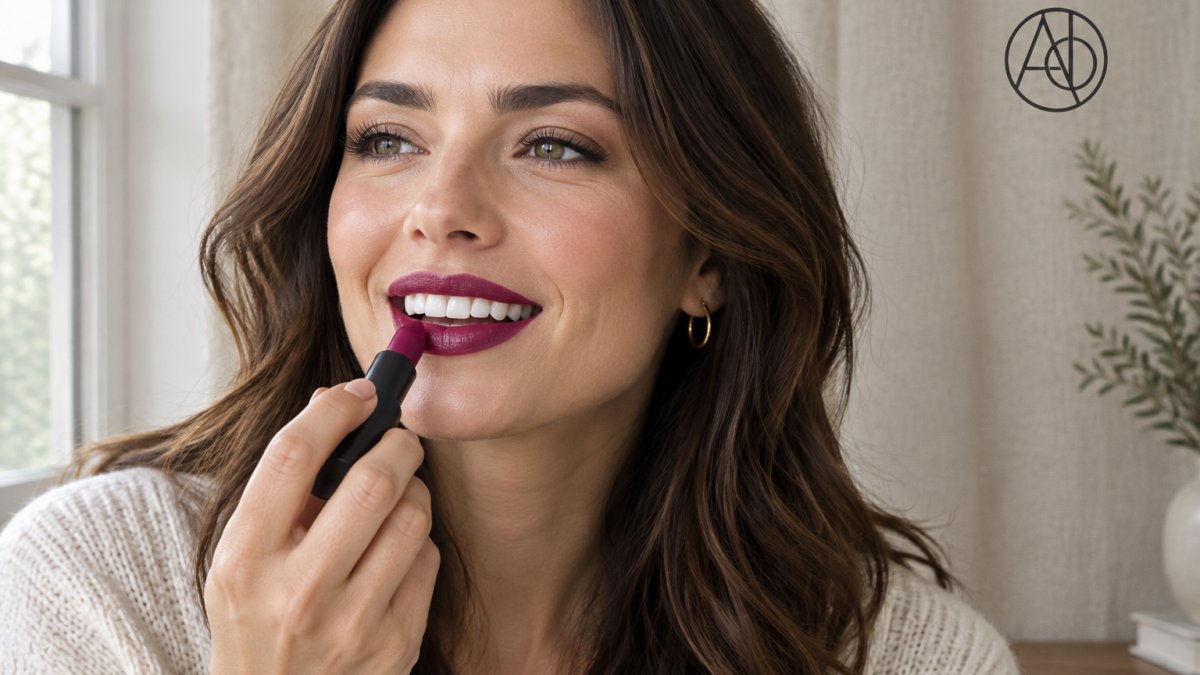
Lipstick colors with a cool base create a contrast edge at the mouth that the eye reads as brightness. That is the whole trick, and it is why the shade matters.
Lipstick Shades to Avoid If You Want a Brighter Smile
Warm-toned shades are the ones that undo the effect. Hawaii Family Dental's guidance on lipstick and tooth appearance cautions against warm reds, coral, peach, beige, caramel, and warm taupe, because their yellow-orange cast can make teeth read less white.
The shades to leave for another day:
- Orange-red and brick red
- Coral and peachy pink
- Warm beige and caramel nudes
- Warm taupe and brown-based neutrals
- Frosted shades with gold shimmer
A common mistake is assuming a nude is neutral. Warm nudes are the sneakiest offenders because they look understated in the tube and yellow-leaning on the mouth. If you want a nude that keeps the smile bright, look for one with a rose or mauve lean rather than a tan one.
Matte Lipstick Colors That Make Teeth Look Whiter
Matte finishes are often a reliable choice for this effect, because a flat finish absorbs light instead of reflecting it. Gloss bounces light off the lips and can pull attention to the warmth in the teeth. Matte does the opposite: it holds a clean, saturated edge of color and lets the contrast do the work.
The mechanism is straightforward light behavior. A glossy finish creates a specular highlight, a bright reflection point on the lip surface. That highlight is the same color as the light source, usually warm indoor lighting, and it sits right next to the teeth. The eye reads that warm highlight as part of the mouth area, which can make the teeth look warmer by comparison.
A matte that goes chalky or patchy breaks the contrast edge, and a broken edge reads as dullness. Pigment load matters because a thin, sheer matte lets the natural lip color show through, which reintroduces warmth at the edges.
Watch out: matte formulas can settle into lip lines and look dry over several hours, which flattens the whole effect. Prepping lips with a thin layer of balm and blotting before applying can help.
How Satin, Gloss, and Metallic Finishes Compare
Finish is not binary. The spectrum from matte to high gloss changes how much light reflects back toward the teeth, and each finish has a different effect on the brightening illusion.
Matte: Can offer a strong brightening effect. No specular highlight, full pigment saturation, and a clean edge. The trade-off is comfort: matte formulas can feel dry and emphasize lip texture.
Satin: A middle ground that most people can wear daily. Satin finishes have a soft sheen but not a sharp highlight, so they reflect some light without creating the warm reflection point that gloss does.
Gloss: The weakest choice for teeth brightening, because the high-shine surface creates a strong specular highlight that reflects the ambient light color. In warm indoor lighting, that highlight is warm, and it sits directly next to the teeth.
Metallic: Can be unpredictable. A cool metallic, such as a silver-flecked berry, may work in evening light, but gold or bronze shimmer can reintroduce the warmth you are trying to cancel.
Watch out: lighting changes the finish equation.
Lipstick Colors That Make Teeth Look Whiter for Fair Skin
Fair skin has the widest runway for cool tones, and the shades that flatter it most are true blue-based reds, raspberry, cherry, and cool rose. The trap for fair complexions is going too pale: a washed-out pink gives the teeth nothing to contrast against.
A quick test for undertone: hold a sheet of white paper beside your bare face in daylight. If your skin reads pink or ruddy against it, you lean cool and can wear blue-based reds and magenta comfortably. If it reads golden, you lean warm and should stay with berry and plum, which carry enough blue to help without clashing. If you read neutral, you can wear both families but should avoid anything that pulls orange.
Fair skin also shows the contrast edge more sharply, so precision matters. Outline the lip with a liner close to your natural tone, then fill. A soft, blurred edge still works, but keep the color dense in the center. For deeper guidance on matching shades to your complexion, our guide on how to choose lipstick for skin tone walks through undertone testing step by step.
Matching Cool Shades to Medium, Olive, and Deep Skin Tones
The contrast principle works across every complexion with adjustments for depth and undertone. The goal is always a cool base, but the depth of the shade should track the depth of your skin so the contrast edge stays visible without looking harsh.
Medium skin with warm or golden undertones: Berry, plum, and blue-based reds work well, but avoid shades that are too dark or they can overwhelm the face. A raspberry or a cool fuchsia gives enough blue to brighten teeth without the heaviness of a deep wine.
Olive skin: Olive undertones can read green or gray, and the wrong cool shade can look ashy.
Deep skin: Deep complexions can carry the most saturated cool shades, and the contrast effect is strongest with rich berries, wines, and blue-based reds at full opacity. The risk for deep skin is going too light: a pale cool pink can look chalky and provide no contrast.
Watch out: testing a shade on the back of your hand only tells you how it looks on your hand, not your lips.
Drugstore Lipsticks That Make Teeth Look Whiter
Drugstore lipsticks can work for this effect, since the shade logic is the same at every price point. Blue-based red, berry, plum, rosy pink. What changes as you move up in price is pigment saturation, wear time, and how the formula feels after six hours.
If you are weighing the two tiers, our piece on luxury vs. drugstore makeup covers what actually separates them. The short answer: at the drugstore you are often paying for filler and fragrance, and at the couture level you are paying for pigment density and finish control.
What to check on a drugstore label:
- Does the shade name suggest blue, berry, wine, or rose?
- Is the finish matte or satin rather than frosted?
- Does the swatch pull orange against white paper?
If the swatch leans orange, put it back. No amount of application skill fixes a warm base.
Maybelline Lipstick for Yellow Teeth: What to Look For
Any lipstick for yellow teeth should be chosen by cool undertone first, finish second, and depth third.
Here is the selection framework we would use in the aisle:
| Step | What to Check | Why It Matters |
|---|---|---|
| 1. Undertone | Blue, berry, or plum in the name or swatch | Neutralizes the yellow cast |
| 2. Finish | Matte or satin, not frosted | Avoids warm light reflection |
| 3. Depth | Medium to deep, not pale | Creates a visible contrast edge |
| 4. Swatch test | Compare against white paper | Reveals hidden orange lean |
Choosing Your Brightening Shade at Artonit
Choosing your brightening shade at Artonit starts with the finish you actually wear. Because creamy and matte finishes can make the same pigment read differently against a smile, Trinity Dental Arts offers another perspective on choosing a tooth-whitening shade that complements your lipstick.
If you want the classic contrast play, start with the Le Rouge R&W reds and wines. For a softer daily option, the Le Rouge P&R pinks and roses carry rosy and berry tones that keep the cool base without the intensity of a full red.


For a nude that does not fight your teeth, the Le Rouge N&F nudes and flesh shades lean rose and mauve rather than tan. That distinction is the whole game in a nude.

Our advice: buy one red, one rose, and one nude, then wear each for a full day before deciding which becomes your signature. Formula comfort matters as much as shade. A color you love but cannot stand wearing by noon is not a color you will reach for.
The hardest part of this is not finding a cool-toned shade. It is committing to one when warm tones have been the default for so long.
Frequently Asked Questions
What lipstick color makes teeth look whiter?
Cool-toned shades create the strongest brightening effect. Blue-based reds, berries, rosy pinks, plum, and magenta increase visual contrast between lips and teeth, so the smile reads whiter. Teeth tend to be perceived as whiter with cool-toned lipstick or colors that boost that contrast. Warm reds, coral, peach, and beige tend to pull out yellow tones instead.
Which lipstick undertones make teeth look yellow?
Warm, yellow-orange undertones are the main culprits. Coral, peach, beige, caramel, and warm taupe can make teeth appear less white because their warmth echoes the yellow in enamel. These shades can work against a brighter smile. If you love a warm tone, keep it away from the teeth line or pair it with a cooler liner.
Do matte lipstick colors that make teeth look whiter work better than glossy finishes?
Matte finishes usually win for smile brightness. A flat, saturated matte absorbs light and deepens the contrast against teeth, while high-gloss finishes reflect light and can soften that contrast. Metallic finishes are the riskiest because their reflective particles can pick up yellow tones. If you prefer cream or gloss, choose a cool-toned shade with strong pigmentation to keep the contrast intact.
Which drugstore lipsticks that make teeth look whiter should I try?
Look for blue-based reds, berry, and cool pink shades on the drugstore shelf, and check the undertone rather than the price tag. Swatch on your inner wrist: a shade that looks slightly purple or blue next to your skin is usually the right pick. Matte drugstore formulas can deliver the contrast you want, but test for dryness and layer a balm underneath if needed.
Does Maybelline lipstick for yellow teeth actually help?
The undertone matters more than the brand, so look for cool-toned shades such as blue-based reds, raspberry, cherry, and cool mauve rather than coral or peach. The same rule applies to any lipstick: cool undertones neutralize yellow hues visually, while warm ones amplify them. Swatch before you buy when possible.
