 Skip to content


How Pigment Particle Size Affects Makeup Performance
Last Updated: November 5, 2026
Quick Summary
Pigment particle size is the average dimension of color particles in a cosmetic formula, measured in microns, and it determines coverage, color intensity, and finish. Smaller particles pack densely for smooth coverage and strong color payoff, while larger particles create sparkle and translucency. The distribution of sizes matters as much as the average.
- A narrow particle-size distribution deposits color evenly, while a broad one creates contrast that reads as depth or unevenness.
- Smaller particles can create smoother coverage while actually reducing opacity, so fineness is not a shortcut to full coverage.
- Over-milling pigments removes the structure that gives them reflectance, leaving color dull and the finish flat.
- Small pearl particles give a soft satin sheen, while larger ones create visible sparkle and a stronger metallic effect.
- Liquid foundations often use fine, narrow distributions with D50 around 1-5 microns for traditional pigments.
Table of Contents
- What Pigment Particle Size Means in Makeup
- How Pigment Particle Size and Coverage Interact
- Fine vs. Coarse Pigments in Makeup
- Pigment Dispersion in Cosmetics: Why Milling Matters
- Pearl Pigment Particle Size and Light Reflection
- Choosing Particle Size by Product Type
- Matching Pigment Size to the Finish You Want
- Frequently Asked Questions
What Pigment Particle Size Means in Makeup
Pigment particle size is the average dimension of the individual color particles suspended in a cosmetic formula, measured in microns. It is one of the most decisive variables in how a product looks, feels, and wears.
Size alone tells you little. What matters is the spread of sizes across a batch, known as particle-size distribution. Two formulas can share the same average micron figure and behave nothing alike.
A tight distribution gives predictable color and texture. A wide one creates contrast between particles, which can read as depth or as unevenness.
Size Versus Particle-Size Distribution
Average size is a single number. Distribution is the full range around it. A formula with a narrow distribution deposits color evenly across the skin. A broad distribution mixes fine and coarse particles, so some areas catch light while others absorb it.
This distinction explains why two eyeshadows labeled identically can swatch differently. The average may match; the distribution does not.
How Pigment Particle Size and Coverage Interact
Coverage is the ability of a formula to visually even out the surface beneath it. Smaller particles pack more densely and scatter light more efficiently, which usually improves coverage. Larger particles leave more gaps, letting skin tone show through.
Opacity, transparency, and hiding power all flow from this same mechanism. Dense fine particles block light from reaching the skin, creating an opaque finish. Coarser particles transmit more light, producing translucency.
Opacity, Transparency, and Hiding Power
Hiding power depends on how much light the particle layer reflects back before it reaches skin. A tightly packed fine layer reflects more, so it hides more.
But there is a limit. According to Neelikon's analysis of pigment performance, smaller particles can create smoother coverage while actually reducing opacity. Smoothness and hiding power are separate outcomes, not the same one.
That single finding reframes the whole conversation. Fineness is not a shortcut to full coverage.
Fine vs. Coarse Pigments in Makeup
Fine pigments deliver smooth, even application and strong color payoff per swipe. Coarse pigments bring texture, visible sparkle, and a lighter feel on the lid. Neither is better; each solves a different problem.
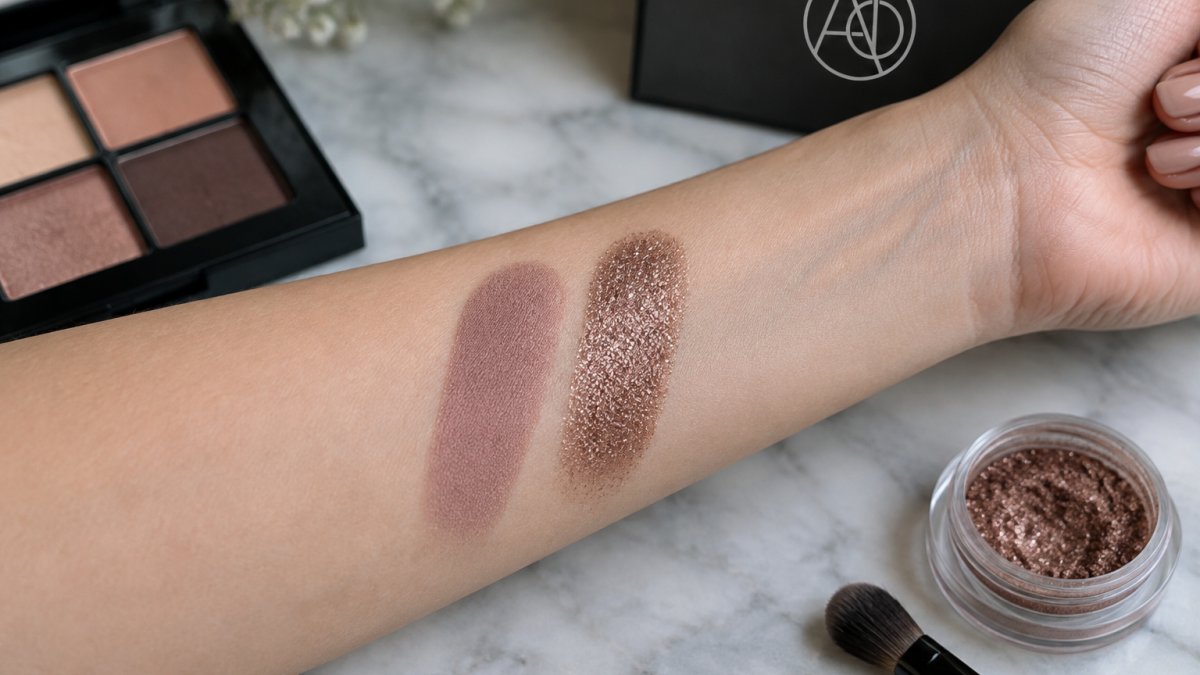
A common mistake is assuming fine always means premium. In practice, a coarse-grade pigment can be exactly what a formula needs to create dimension and light play.
Color Intensity and Tinting Strength
Color intensity is how vividly a pigment reads on skin. Tinting strength is how far a small amount of pigment stretches. Both rise when particles are small, because more surface area means more light interaction per gram of product.
Our guide to choosing high pigment makeup shades goes deeper on matching intensity to skin tone and undertone.
Fine particles also disperse more readily, so a little goes further. That is why a finely milled shadow can look saturated in one pass while a coarse one needs building.
Pigment Dispersion in Cosmetics: Why Milling Matters
Dispersion is the process of breaking pigment clusters apart and spreading them evenly through a base. Milling is the mechanical work that achieves it. Poor dispersion leaves agglomerates, which show up as streaks, patchiness, and uneven color.
The Society of Cosmetic Chemists' discussion of dispersion cautions that pigments can be over-milled. Reducing particle size is not an unlimited path to better performance.
Over-Milling and the Limits of Fineness
Push milling too far and particles lose the structure that gives them reflectance. The formula gets smoother but flatter. Color can dull, and the finish loses its dimension.
So the goal is not maximum fineness. It is the right particle size and distribution for the effect you want.
Pearl Pigment Particle Size and Light Reflection
Pearl pigments work differently from traditional pigments. They do not simply absorb and scatter light; they reflect it in layers, creating shimmer, sparkle, and metallic effects. Particle size controls the scale of that reflection.
Small pearl particles produce a soft satin sheen. Larger ones create visible sparkle and a stronger metallic effect. Particle reflectance also shifts with size, changing how bright the finish appears from different angles.
You can see this principle at work in our Mother of Pearls shades, which are built around pearl pigments.

Shimmer, Sparkle, and Metallic Effects
Shimmer is a fine, uniform glow. Sparkle is discrete points of light. Metallic effect is a mirror-like finish. All three come from the same family of effect pigments, differentiated largely by particle size and shape.
Choosing Particle Size by Product Type
Particle size does not behave the same way across product categories. A profile that works in a pressed eyeshadow can fail in a liquid foundation, and a highlighter that looks refined in the pan can read as chunky on skin.
| Product Type | Typical Particle Profile | Finish Result | Key Trade-Off |
|---|---|---|---|
| Liquid foundation | Fine, narrow distribution (often D50 around 1-5 microns for traditional pigments) | Smooth, even coverage | Finer particles improve coverage but can reduce opacity if over-dispersed |
| Concealer | Fine to medium, tight distribution | High hiding power with blendability | Too fine can flatten texture; too coarse can settle into lines |
| Pressed eyeshadow | Fine to medium, tight distribution | Smooth, even payoff | Coarse particles increase fallout; fine particles can press hard and resist pickup |
| Shimmer topper | Coarse pearl particles (often 10-50 microns) | Visible sparkle | Larger particles create more sparkle but can feel gritty and settle unevenly |
| Blush | Medium, balanced distribution | Soft, buildable color | Broad distribution can read as patchy on textured skin |
| Setting powder | Very fine, uniform | Blurred, matte surface | Overly fine powders can kick up dust and look chalky |
| Highlighter | Medium to coarse pearl | Reflective glow | Coarse pearl can emphasize pores and texture |
These ranges are starting points, not rules. Most practitioners find that the distribution matters as much as the average: a foundation with a narrow distribution around 3 microns behaves very differently from one with a broad spread from 1 to 15 microns, even if both report a similar D50.
In foundation and concealer, smaller particles pack more densely and scatter light more efficiently, which usually improves coverage. But as noted earlier, pushing fineness too far can reduce hiding power. The practical balance is a fine enough particle to smooth texture without over-milling the pigment into a flat, translucent layer.
In blush, a medium particle size with a balanced distribution gives buildable color that does not immediately look heavy. A very fine blush can be harder to control because it disperses quickly and can look patchy on first application.
In highlighter and shimmer toppers, pearl pigments dominate. Small pearl particles produce a soft satin sheen, while larger ones create visible sparkle. The trade-off is that larger pearl particles reflect more light but also sit higher on the skin, which can emphasize pores and fine lines.
Setting powders rely on very fine, uniform particles to blur the surface. But overly fine powders can become airborne during application and can look chalky if the distribution is too narrow and the powder lacks enough larger particles to prevent settling into a flat matte.
Watch out: choosing a particle profile by average micron alone can lead to a formula that swatches well but wears poorly, because the distribution and the base chemistry determine how the particles deposit and stay on skin.
Our Ombres Artistiques eye colors use finely milled pigment for intense payoff with minimal fallout, and our Mother of Pearls shades are built around pearl pigments with particle sizes selected for their intended shimmer level.

Matching Pigment Size to the Finish You Want
Most guides stop at the idea that matte needs fine particles and shimmer needs coarse ones. That is true as far as it goes, but it does not help you choose a pigment when a supplier sends a specification sheet with D10, D50, and D90 values and you need to predict how the formula will look and wear.
A practical workflow starts with the finish, then moves to the distribution, then to the base chemistry. Here is how to work through it.
Step 1: Define the finish in measurable terms. Matte means low reflectivity and high diffuse scattering. Satin means a soft sheen with some directional reflection. Shimmer means visible points of light. Metallic means a mirror-like reflection. Each of these corresponds to a different particle-size range and, just as importantly, a different distribution width.
Step 2: Read the distribution, not just the average. A specification sheet typically reports D10, D50, and D90, the particle sizes below which 10%, 50%, and 90% of the distribution falls. A narrow distribution has D10 and D90 close to D50. A broad distribution has a wide gap.
Step 3: Match the distribution to the base. A fine, narrow distribution disperses easily in a liquid foundation but can be harder to wet out in a pressed powder. A coarse distribution may need more binder to prevent fallout in a pressed format. Most practitioners find that the base chemistry and the dispersion method matter as much as the particle size itself.
Step 4: Test the trade-offs. Finer particles improve smoothness and color intensity but can reduce opacity and, if over-milled, flatten reflectance. Coarser particles improve sparkle and light play but can feel gritty, settle unevenly, and emphasize skin texture. The right choice depends on which trade-off matters most for the product.
For a matte result, look to finely milled formulas like our Focus The Mattes. Once you have chosen a finish, our guide to maintaining pigment intensity all day covers how to keep it looking fresh through long wear.

Frequently Asked Questions
How does pigment particle size affect makeup coverage?
Smaller particles pack more densely and scatter light more evenly, which usually improves coverage and opacity. Larger particles leave more space between them, so light passes through and the finish looks sheerer. That is why a finely milled pressed powder can hide redness while a coarse shimmer shade reads as a translucent wash of color. The trade-off is that extremely fine particles can lose some hiding power, so formulators balance size against the look they want.
Do smaller pigment particles create more intense color?
Not automatically. Smaller particles expose more surface area, which can strengthen tinting strength and make color look richer per swipe, but over-milling can dull the payoff. Color intensity also depends on pigment grade, concentration, and how evenly the pigment is dispersed in the formula, not on size alone.
What is the difference between fine and coarse pigments in makeup?
Fine pigments are milled to a small, uniform size and tend to apply smoothly, blend easily, and deliver opaque, saturated color with a soft finish. Coarse pigments are larger and often used for shimmer, sparkle, and metallic effects because their surfaces reflect light in visible flashes. Coarse particles can feel more textured and may show fallout, while fine particles can look flatter. Many formulas combine both grades to get color depth plus dimension.
How does pigment size affect shimmer and reflectivity?
Shimmer comes from light bouncing off particle surfaces, so larger pearl and effect pigments create bigger, more visible flashes of sparkle. Smaller pearl particles reflect light more diffusely, producing a satin sheen rather than distinct glitter. The base pigment underneath matters too: a fine color layer with a coarse pearl overlay gives depth and dimension. For a high-impact finish, look for formulas that pair a fine-grade pigment base with a controlled coarse pearl particle size.
Particle size is not a spec sheet detail. It is the decision that shapes how a product looks and wears. At Artonit, we formulate in small batches with pigment-saturated formulas, named shades, and hand-finished detail, so the science serves the artistry. Explore Ombres Artistiques and discover the vision for yourself.
