 Skip to content


Pat McGrath Alternative for Creative Makeup
Table of Contents
- What Makes a Pat McGrath Alternative for Creative Makeup
- Luxury Indie Makeup Brands: What Sets Them Apart
- Pigment-Saturated Eyeshadow Palettes for Editorial Looks
- Drugstore vs. Luxury Performance: Where the Difference Shows
- Application Techniques for Creative Makeup
- Longevity and Wear Time: What to Expect
- Sustainability and Ethical Sourcing in Luxury Beauty
- Conclusion
- Frequently Asked Questions
Last Updated: September 16, 2026
What Makes a Pat McGrath Alternative for Creative Makeup
A Pat McGrath alternative for creative makeup is any pigment-saturated formula that delivers editorial-level color payoff, blendability, and wear without the flagship price. Small-batch houses now source the same pigment families and press them with tighter quality control, narrowing the gap.
Here is what separates a real alternative from a lookalike:
- Pigment load, measured by how much color reaches the lid in one pass
- Binder quality, which decides whether a shade blends or patches
- Finish range, from flat matte to light-shifting multichrome
- Wear time under real conditions, not a swatch photographed in a studio
Luxury Indie Makeup Brands: What Sets Them Apart
Luxury indie makeup brands compete on production scale, not marketing budget. A house pressing a few hundred units per shade can afford slower milling and a final hand check a mass line cannot. Finer milling means the powder adheres evenly instead of sitting on top of the skin, with less fallout.
Small-Batch Craftsmanship and Ingredient Match
An ingredient match compares two formulas by what actually carries the pigment, not by shade name. Mica, boron nitride, kaolin, and zinc stearate do the heavy lifting in most pressed shadows; when two palettes share that base, the gap comes down to pigment concentration and pressing pressure.
Pigment-Saturated Eyeshadow Palettes for Editorial Looks
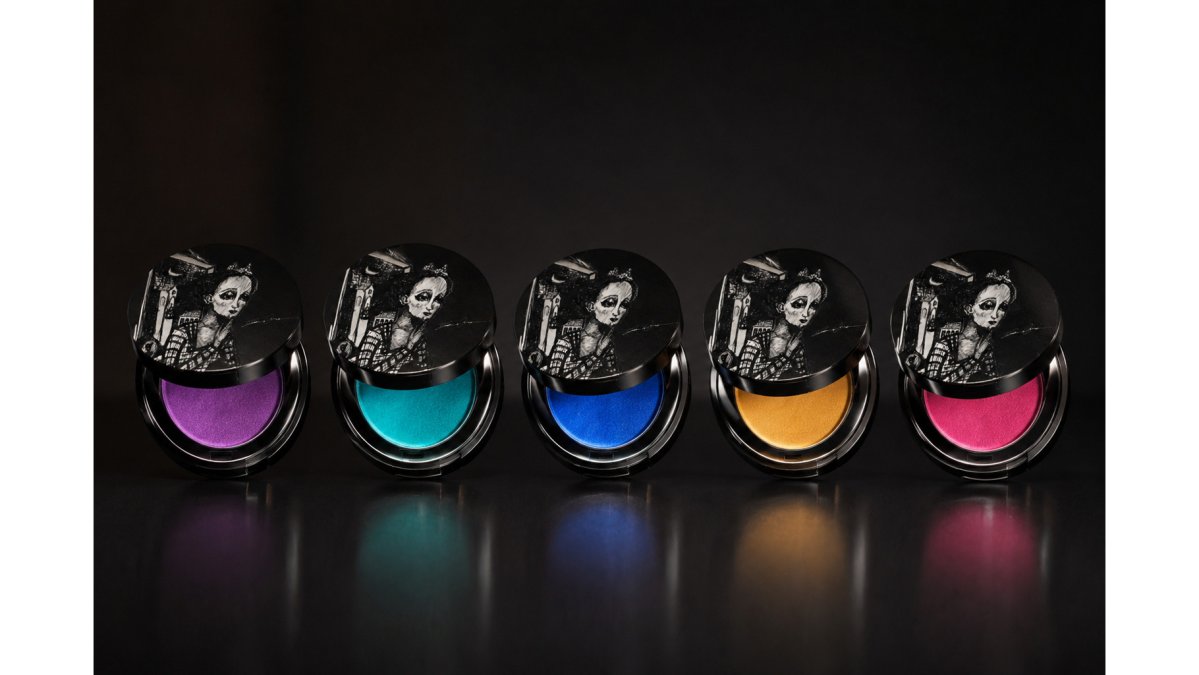
Pigment-saturated eyeshadow palettes are built for one-pass color: a single dip covers the lid without building. Editorial work demands this because bright light flattens weak pigment.
Matte, Shimmer, and Multichrome Finishes
Finish determines how a shade behaves on camera and matters more than color for editorial work.

| Finish | Best For | Application | Example Shade |
|---|---|---|---|
| Matte | Sculpting the crease, graphic lines | Dry brush, build in layers | Vert (MOI & MOI) |
| Shimmer | Lid wash, soft dimension | Fingertip or flat brush | Grind Gold (MOI & MOI) |
| Iridescent | Light-catching accents | Damp brush for intensity | Venus, Eclipse (MOI & MOI) |
| Multichrome | Statement looks, shifting color | Damp brush, pat not sweep | Ombres Irisées |
Drugstore vs. Luxury Performance: Where the Difference Shows
The gap is narrower than the price tags suggest, but it does not disappear. Drugstore formulas have improved in blendability; where they still fall short is pigment density at the top end and finish complexity.
Here is where the two diverge in practice:
| Factor | Drugstore | Luxury / Small-Batch |
|---|---|---|
| Pigment load | Moderate, needs building | High, one-pass coverage |
| Binder system | Standardized, cost-driven | Formulated per finish |
| Shade range | Broad but shallow per finish | Curated, deeper per shade |
| Wear time | Fades on oily lids | Holds with primer |
| Fallout | More common | Minimal with fine milling |
Why the Gap Exists at the Ingredient Level
The difference is the ratio of pigment to filler. Most mass-market pressed shadows use talc as the primary bulking agent because it is cheap and fills a pan fast. Talc also has a hard, chalky particle shape that scatters light instead of reflecting it, which is why drugstore mattes can look flat on camera even when the color is correct.
How to Test the Gap Yourself
You do not need a lab to tell the difference. Run this three-part test on any palette before you commit:
- The one-pass test. Dip a flat brush once, tap off the excess, and press the shade onto a primed lid. If you can see skin through the color, the pigment load is moderate. If the color is opaque, it is high.
- The finger-pad test. Swipe a shimmer across the pad of your finger and hold it under a window. A single-layer shimmer looks like one flat color. A layered shimmer shifts tone at the edges.
- The tissue test. Press a shadow onto a white tissue and rub. Heavy fallout leaves a trail of loose powder. Fine milling leaves almost nothing behind.
The Trade-Off Nobody Mentions
The one drawback of small-batch production is availability: shades sell through and restock on a slower cycle. Mass-market lines win on consistency and restock speed; small-batch lines win on pigment density and finish range. Neither is universally better, it depends on whether you are building a signature look or a rotating kit.
Application Techniques for Creative Makeup
Application is where a good palette becomes an editorial look. Three techniques carry most of the weight.
Wet vs. Dry Application for Color Payoff
Wet application intensifies color and adds dimension, and is the fastest way to test whether a formula is truly pigment-rich: dampen the brush, tap off the excess, then pat the shade onto the lid. Dry application gives a softer, more diffused result for daytime wear.
Longevity and Wear Time: What to Expect
Wear time depends more on your primer and lid type than on the palette. On a primed lid, a densely pigmented shadow typically holds through a full workday; on an unprimed oily lid, even a luxury formula will crease. Here is how to measure wear so you can compare formulas on your own skin.
A Simple 8-Hour Wear Test You Can Run at Home
Pick a day when you will be indoors and outdoors, not sitting in one room. Apply your look at a fixed time, then check in at the four-hour and eight-hour marks under the same lighting. Score each factor on a 1-to-5 scale:
- Color intensity. Has the shade faded, or is it still close to the original application?
- Crease depth. Is the color sitting in the crease, or has it migrated above it?
- Fallout. Are there specks under the eye that were not there at application?
- Edge integrity. Are graphic lines still sharp, or have they blurred into the surrounding color?
How Finish Changes Wear Time
Not all finishes age the same way. Matte shades hold color longest because they contain more pigment and less reflective filler. Shimmers can dull as the mica settles into the crease. Multichromes are the most fragile, the thin-film layers that create the shift break down under oil, so a multichrome that looks stunning at hour one can look muddy by hour six on an oily lid.
Skin Type Changes Everything
A formula that holds for twelve hours on a dry lid may crease in three on an oily one. If your lids are oily, the single most effective change is a mattifying primer, not a more expensive shadow. Let it set for a full minute before applying color, most primers need that time to form the grip layer that holds pigment.
Building for a 12-Hour Day
For long days, the practical combination is a matte base, a shimmer accent packed on top, and a waterproof liner to finish. The Define Precision Liquid Liner is fast-drying and waterproof, with a super fine tip for razor-thin lines or graphic shapes, enriched with Vitamin B and Ascorbyl Palmitate to condition the delicate eye area.
Three habits extend wear regardless of formula:
- Prime the lid and let it set for a full minute before color
- Set cream products with a matching powder
- Avoid layering more than three shades in the crease, which adds weight and speeds creasing
Sustainability and Ethical Sourcing in Luxury Beauty
Ethical sourcing in luxury beauty comes down to two questions: what is in the formula, and how was it tested. Vegan status means no animal-derived ingredients; cruelty-free status means the finished product was not tested on animals.
Conclusion
Choosing a Pat McGrath alternative for creative makeup comes down to pigment load, binder quality, and whether the finish range matches the looks you actually build. Small-batch houses now compete on formula rather than logo.
Frequently Asked Questions
What makes a makeup brand a suitable Pat McGrath alternative for creative, high-fashion looks?
A suitable Pat McGrath alternative needs three things: intense pigmentation, seamless blendability, and finishes that hold up under editorial lighting. Look for formulas with finely milled textures, minimal fallout, and the ability to layer without turning muddy. Palettes that offer matte, shimmer, and iridescent finishes in one compact give you the range to build multidimensional looks. Small-batch production also matters because it often means tighter quality control on pigment saturation and texture consistency.
How do luxury indie makeup brands compare to established runway makeup houses?
Luxury indie makeup brands often match or exceed runway houses on pigment density because they produce in smaller batches with less pressure to cut costs on raw materials. The trade-off is typically a narrower shade range and limited restocks. Established houses have broader distribution and seasonal collections, but indie brands tend to focus on formula innovation and named shades that stay in the line longer. For creative makeup, the deciding factor is usually whether the brand prioritizes color payoff over packaging volume.
What should artists look for in pigment-saturated eyeshadow formulas?
Start with the texture: finely milled shadows with ingredients like mica, boron nitride, and kaolin tend to deliver smooth, even color without fallout. Check whether the formula works wet or dry, since dampening a brush intensifies color payoff and adds dimension. Talc-free and paraben-free formulas are worth prioritizing if you have sensitive eyes. Also look for buildable intensity, meaning you can apply a sheer wash or layer to full opacity without the shadow skipping or creasing.
Are there luxury makeup brands that prioritize small-batch craftsmanship?
Yes. Several luxury indie makeup brands produce in small batches to maintain tighter control over pigment quality and texture. Small-batch production means each run is hand-finished and inspected, which reduces the inconsistency that can happen with mass manufacturing. The downside is limited inventory, so popular shades may sell out. If you find a formula you rely on, it is worth reordering when it is in stock rather than waiting until you run out.
How does Artonit compare to traditional high-end makeup brands for editorial looks?
Artonit focuses on pigment-saturated formulas with named shades rather than numbered ones, which suits artists who build looks around a color story. The eyeshadows use a finely milled, talc-free formula with minimal fallout, and the compacts include matte, shimmer, and iridescent finishes in one palette. For editorial work, the key difference is that Artonit designs for layering and wet application, giving you the control to go from a soft wash to full-intensity color without switching products.